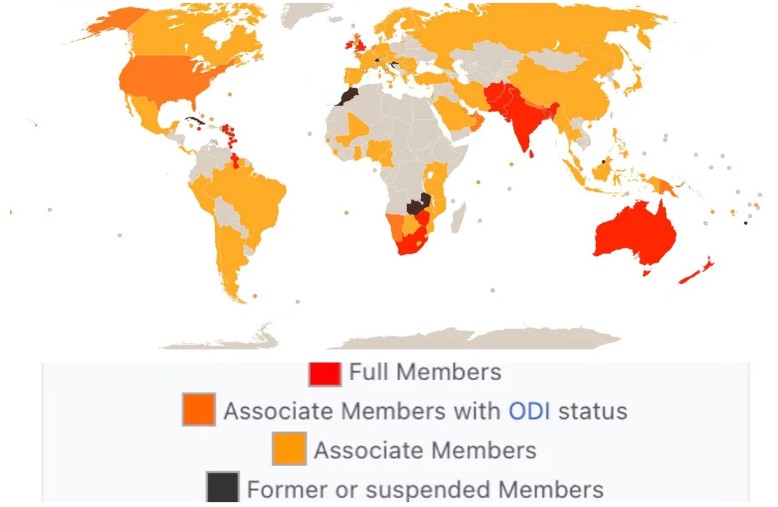
While global cricket conversations naturally gravitate towards World Cups, bilateral series, and high-octane franchise leagues, one of the most vital financial mechanisms sustaining the sport operates far from the limelight. For many of the International Cricket Council's (ICC) Associate Members, the opportunity to host pathway tournaments is more than a logistical responsibility; it is a crucial economic catalyst that directly strengthens domestic cricket ecosystems.
To understand how Associate cricket continues to expand its footprint across continents, it is essential to examine how the ICC’s event hosting model quietly provides financial stability and long-term development momentum.
The ICC’s qualification pathways—spanning T20 World Cups, ODI World Cups, and U19 global events—require a dense calendar of regional and sub-regional tournaments. These events must be staged across diverse geographies, often in emerging cricket nations where infrastructure and funding remain works in progress.
This is where the hosting model becomes transformative. When an Associate Member is awarded a qualification pathway event, the ICC does not simply assign the tournament and step away. Instead, the event arrives with a structured funding and operational support framework designed to offset costs and inject capital directly into the local cricket economy. For many boards, this funding represents one of the most significant financial inflows outside of their annual ICC grants.
Organizing an international cricket tournament carries substantial costs that many Associate boards would struggle to shoulder independently. Venue preparation, pitch upgrades, broadcast arrangements, and complex logistics all require investment. The ICC pathway tournaments change that equation by providing hosting support that covers major operational expenses.
This funding typically encompasses:
Venue preparation and match operations
Accommodation and travel for participating teams and officials
Broadcast and digital coverage support
Event management and logistics infrastructure
Match officials and technical staff costs
This financial framework removes the significant risk from hosting, allowing boards to stage multi-nation events without jeopardizing their annual budgets. Instead of draining local resources, the process becomes financially neutral and, in many cases, financially positive for the host nation.
Beyond the immediate financial injection, hosting serves as a catalyst for permanent physical growth. To meet international standards, host boards often use a portion of the event funding to invest in their facilities. This frequently leads to improvements in pitch and outfield quality, the installation of high-performance practice facilities, and upgrades to ground equipment and technology.
These enhancements remain long after the final ball is bowled, strengthening the domestic game and improving the nation's ability to host future international fixtures. For many Associate nations, these ICC events are the defining moments that transform local grounds into internationally viable venues, ensuring the sport's foundations are built on solid, world-class soil.
|